Enhanced Skin Lesion Classification Web Application with GAN-Based Augmentation and Deep Learning
Full-stack dermoscopy classification using Enhanced SE-ResNet and ACGAN-based augmentation (5 classes, 97.23% accuracy).
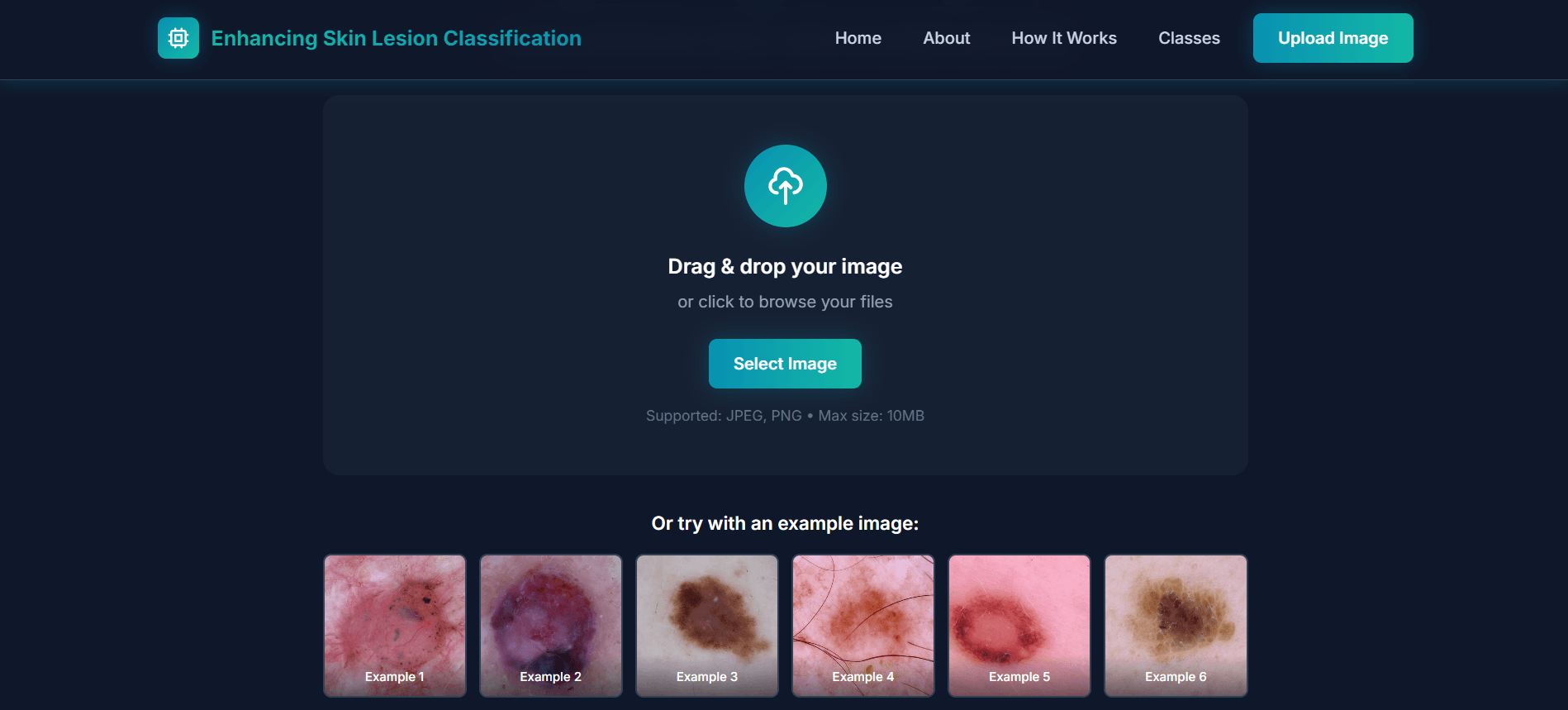
Overview
An intelligent full-stack web application for classifying dermoscopy images into 5 skin lesion categories. The system combines an Enhanced SE-ResNet architecture with ACGAN-based data augmentation to address class imbalance and achieves 97.23% accuracy on the HAM10000 dataset.
The Problem
Skin lesion datasets suffer from severe class imbalance and image artifacts (e.g. hair), which significantly reduce model performance—especially for critical minority classes such as melanoma.
The Solution
Enhanced SE-ResNet50 with multi-stage SE blocks across all ResNet layers • ACGAN-based augmentation to generate class-conditional samples for minority classes (MEL, AKIEC) • Image preprocessing using black-hat transform and inpainting for hair removal • FastAPI backend + React frontend for real-time inference and visualization
Key Features
- ▸5-class lesion classification (NV, MEL, BKL, BCC, AKIEC)
- ▸Minority class performance improvement via GAN augmentation
- ▸Before/after hair removal visualization
- ▸Probability distribution charts for predictions
- ▸Fast inference suitable for interactive web usage
Architecture
Frontend: React + Vite + Tailwind • Backend: FastAPI (REST), PyTorch inference service • ML Pipeline: Preprocessing → Enhanced SE-ResNet → Prediction • Deployment: Production-ready API with validation and auto-documentation
Performance
- ▸Accuracy: 97.23%
- ▸Macro F1: 95.39%
- ▸Macro Precision: 95.83%
- ▸Macro Recall: 94.99%
My Contribution
Full-stack web application development (React UI + FastAPI backend) • Inference API design and efficient model loading strategy • Integration of preprocessing, prediction, and visualization pipeline • Deployment, documentation, and live demo setup • (Model research & training conducted in collaboration.)
Legal Notice
Educational and research purposes only. Not a medical device.